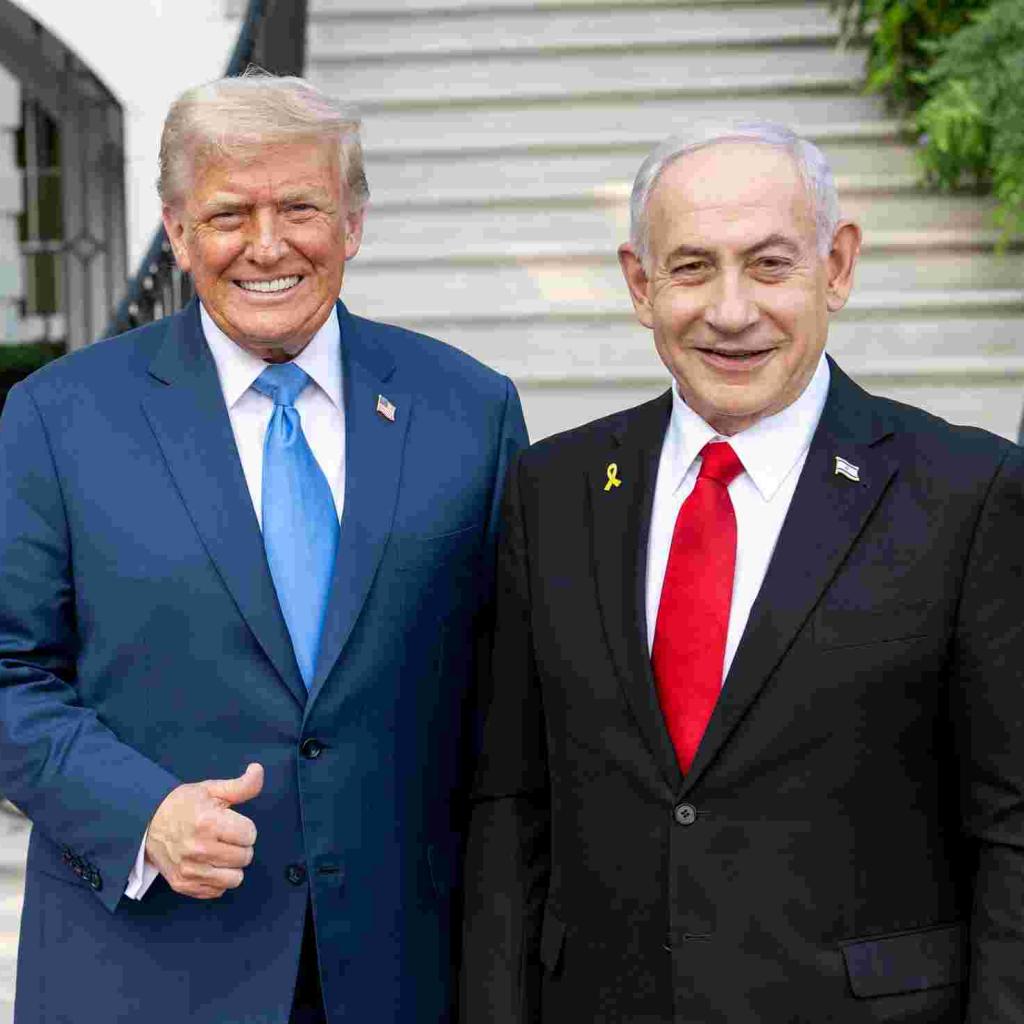
Washington: A high-stakes phone conversation between former US President Donald Trump and Israeli Prime Minister Benjamin Netanyahu has come under intense global focus after reports revealed it took place less than 48 hours before a major US-Israeli military strike in Iran that resulted in the death of Iranian Supreme Leader Ayatollah Ali Khamenei.
According to a report by Reuters, the critical discussion between the two leaders occurred at a decisive moment when intelligence agencies believed Khamenei would soon meet key senior officials at his compound in Tehran. The gathering was seen as a rare strategic opportunity for what military experts describe as a “decapitation strike,” an operation targeting the top leadership of a nation to disrupt command structures.
Sources cited in the report indicated that fresh intelligence suggested the planned meeting had been rescheduled to Saturday morning instead of Saturday night, prompting urgency in decision-making. The shift reportedly played a role in accelerating final discussions between Washington and Tel Aviv regarding the timing and execution of military action.
During the call, Netanyahu reportedly stressed that such an opportunity to eliminate Iran’s top leadership might not arise again. The Israeli leader also referenced previous alleged Iranian attempts to target Trump, including a 2024 murder-for-hire plot that US authorities claim was orchestrated as retaliation for the 2020 killing of Iranian military commander Qassem Soleimani.
Netanyahu’s Strategic Argument
Reports suggest that Netanyahu framed the operation as a historic opportunity to significantly weaken Iran’s leadership structure, which Western nations have long accused of contributing to regional instability. According to sources familiar with the conversation, the Israeli Prime Minister argued that decisive action could potentially encourage internal dissent within Iran and weaken the country’s current political establishment that has been in place since the 1979 Islamic Revolution.
Intelligence assessments had already prompted the United States to increase its military presence in the Middle East weeks before the phone call. The buildup indicated that preparations for a possible strike were underway, with weather conditions reportedly delaying an earlier planned date for military action.
According to Reuters, individuals briefed on the discussions believe Netanyahu’s arguments, combined with intelligence suggesting a limited window of opportunity, contributed to Trump’s final approval of Operation Epic Fury on February 27. Military strikes reportedly began early the following morning, February 28, with Trump later announcing that Khamenei had been killed.
White House spokeswoman Anna Kelly later said the joint operation aimed to "destroy the Iranian regime's ballistic missile and production capacity, annihilate the Iranian regime's Navy, end their ability to arm proxies, and guarantee that Iran can never obtain a nuclear weapon."
Israel Rejects Claims of Pressuring the US
Netanyahu has rejected claims suggesting that Israel pushed the United States into war with Iran, dismissing such reports as "fake news". Addressing reporters, he said, " Does anyone really think that someone can tell President Trump what to do? Come on."
Trump has also maintained publicly that the decision to authorise military action was made independently. However, Reuters reports suggest that Netanyahu’s presentation of intelligence and strategic opportunities may have influenced the final decision-making process.
US Defence Secretary Pete Hegseth appeared to suggest that retaliation played a role in the operation, stating, "Iran tried to kill President Trump, and President Trump got the last laugh."
Background to the Conflict
During his 2024 election campaign, Trump had emphasised avoiding direct war with Iran, expressing preference for diplomatic engagement over military confrontation. However, negotiations surrounding Iran’s nuclear programme reportedly failed to reach a breakthrough last year, increasing tensions between the nations.
A major escalation took place in June, when Israeli forces targeted Iranian nuclear and missile facilities, killing several senior Iranian figures. US forces later joined the military campaign, which lasted 12 days. Trump later described the operation as a success, stating that the US had "obliterated" Iran’s nuclear capabilities.
Subsequent discussions between US and Israeli officials reportedly focused on further operations aimed at dismantling Iran’s missile infrastructure and limiting its capacity to develop nuclear weapons. Israeli officials also viewed Khamenei as a long-standing geopolitical adversary who had supported armed proxy groups such as Hamas and Hezbollah.
Defence Minister Israel Katz told Israel’s N12 News that initial planning for the operation assumed Israel might have to act independently. However, discussions intensified after Netanyahu met Trump at Mar-a-Lago in December, where concerns about Iran’s missile programme were raised.
Factors Influencing the Final Decision
Two significant developments reportedly influenced Trump’s decision to proceed with further military action. One was a January 3 operation targeting Venezuelan President Nicolas Maduro, which demonstrated the potential for complex missions to be conducted without significant American casualties.
Another factor was a large-scale anti-government protest movement inside Iran, which was met with a strong crackdown by the Islamic Revolutionary Guard Corps. Reports indicate thousands were killed during the unrest, further intensifying geopolitical tensions.
Cooperation between Israel Defence Forces and the US Central Command (CENTCOM) reportedly increased in the months leading up to the strike, with joint planning sessions taking place privately between military officials.
US Secretary of State Marco Rubio reportedly informed congressional leaders on February 24 that Israel was likely to launch strikes against Iran regardless of US participation, warning that Iran would likely respond with counterattacks against American assets and allies in the Gulf region.
Regional Impact and Ongoing Tensions
The military strikes and subsequent developments have had major regional consequences. Reports indicate Iranian retaliatory actions targeted US military assets and affected strategic shipping routes, contributing to rising oil prices globally.
More than 2,300 Iranian civilians and at least 13 US service members have reportedly died in the conflict, highlighting the significant human cost of escalating tensions. The situation has also led to security concerns across the Middle East, with heightened alert levels among regional allies.
Despite speculation that the killing of Iran’s leadership could trigger political change, US intelligence agencies reportedly assessed that a successor would likely emerge from within the existing power structure. Khamenei’s son, Mojtaba, has reportedly assumed leadership, and is considered by analysts to hold strong anti-American views.
With the conflict continuing into its fourth week, tensions remain high across the region. Iranian Revolutionary Guard forces continue to maintain a strong presence domestically, while millions of citizens remain indoors amid uncertainty about future developments.
The developments underscore the fragile balance of power in the Middle East and highlight the far-reaching implications of strategic decisions made at the highest levels of global leadership.
Source : NDTV
Image Source : WIKIMEDIA COMMONS