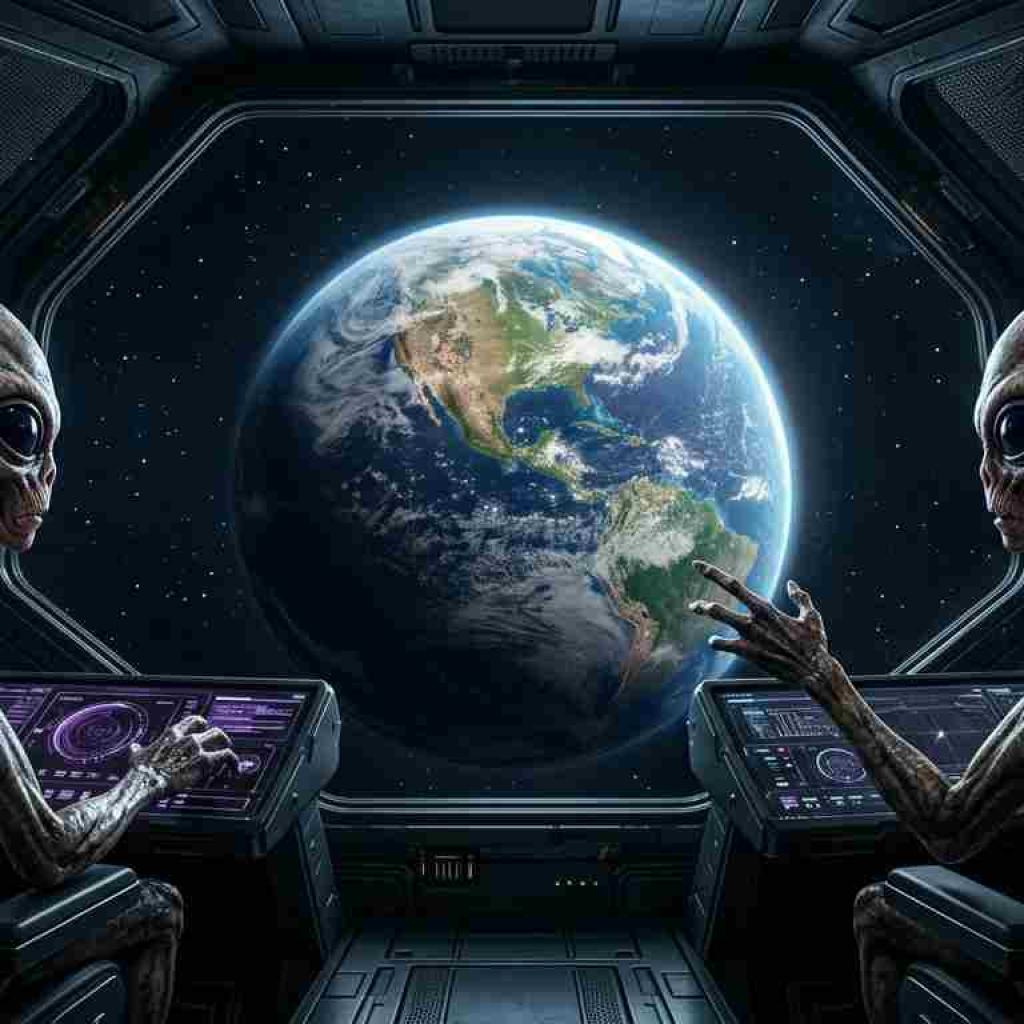
For decades, humanity has been fascinated by the possibility of life beyond Earth. Now, renewed attention has emerged after former US President Donald Trump ordered the release of government files related to UFOs, sparking global discussion about extraterrestrial life and what such beings might think about humans if they truly exist.
The idea of alien life has long been part of scientific research, popular culture, and public curiosity. However, the current debate has shifted focus toward a thought-provoking question: if intelligent beings from another planet were observing Earth, how would they perceive human behaviour, conflicts, and technological progress?
“If I were looking at Earth from a distance, I would be pretty disappointed,” theoretical physicist Avi Loeb says. “Most of our investing is dealing with conflicts to prevent other people from killing us or us killing others. Look at the Ukraine war over a little bit of territory. That is not a sign of intelligence."
Public interest in unidentified flying objects (UFOs) increased significantly after former US President Barack Obama addressed the topic during a podcast interview. Obama stated that aliens are “real,” but clarified that he “hasn’t seen them” and that “they’re not being kept at Area 51.” His remarks sparked widespread discussion and renewed curiosity about whether intelligent life exists beyond Earth.
Following this surge in interest, Trump announced through social media that he had directed the release of government files due to “tremendous interest” from the public. The move has generated excitement among researchers, enthusiasts, and those hoping for greater transparency about unexplained aerial sightings.
At the same time, space exploration missions continue to expand humanity’s understanding of the universe. NASA’s Artemis II mission, which aims to send astronauts on a journey around the Moon, reflects humanity’s continued efforts to explore space and search for clues about life beyond Earth.
Many scientists believe that given the vast size of the universe, the possibility of life elsewhere is high. A 2021 survey conducted by Pew Research Center revealed that around two-thirds of Americans believe intelligent life may exist on other planets.
“We don’t want to think this is the only place in this extraordinarily and incomprehensibly large universe where life and intelligence and even technology have emerged,” says Bill Diamond, president and chief executive of the SETI Institute. “It sort of says about humans, ’We don’t want to be alone.'"
Something is up there. But what?
Human curiosity about alien life dates back many decades. In 1947, debris recovered near Roswell, New Mexico, initially sparked claims of a flying disc before authorities later clarified it was a weather balloon. Despite the explanation, the incident fuelled conspiracy theories and helped shape modern fascination with UFOs.
Over time, depictions of aliens became a major part of entertainment, appearing in films, television shows, and science fiction literature. The iconic franchise Star Trek even commemorates April 5 as “First Contact Day,” imagining the moment when humans make contact with extraterrestrial beings in the future.
Some experts suggest that the common portrayal of aliens as hostile invaders reflects human fears and behaviour. According to Priscilla Wald, many fictional stories depict aliens as violent because humanity often projects its own conflicts onto imagined life forms.
“It seems to me it’s a reflection on who we are, that we’re projecting onto aliens the way we treat each other," Wald says. "So the aliens are coming down, they want to conquer us, they’re violent. Who does that sound like? It sounds like us.”
In recent years, the term UFO has increasingly been replaced by UAP, meaning unidentified aerial phenomena or unidentified anomalous phenomena. In 2024, the Pentagon released numerous reports related to unexplained aerial sightings, but none confirmed extraterrestrial origins.
Personal experiences and unanswered questions
Several individuals claim to have witnessed unexplained objects in the sky. Debbie Dmytro, a medical professional from Michigan, reported seeing unusual lights moving in formation without sound. While she acknowledges that some sightings could be drones or aircraft, she believes some incidents remain difficult to explain.
“Four yellow lights, yellowish golden lights and they were all flying very, very low,” Dmytro remembers. She says the lights were about 100 feet (30 meters) up at their nearest.
“I’ve never seen anything so low without any noise and flying in complete uniformity,” she says. “Is it something man-made? Is it something that’s not manmade? Who knows?”
Scientists emphasise that unidentified aerial sightings do not automatically mean alien activity. Often, these objects turn out to be advanced aircraft, drones, natural atmospheric events, or observational errors. However, researchers agree that further scientific investigation is necessary to understand such phenomena.
“Absolutely, there are such things” as UAPs and UFOs, says Diamond. “People observe things in the sky that they can’t immediately identify or recognize as either human engineering such as planes or drones or helicopters, or animals, such as birds, and therefore they don’t know what they are."
Time for the truth
Some experts argue that governments should release more information about unexplained aerial sightings to allow scientists to analyse the data more openly. Retired Rear Admiral Timothy Gallaudet believes evidence confirms the presence of unexplained objects moving in airspace and oceans.
“The nonhuman intelligence that operates them or controls them are absolutely real,” Gallaudet says. “We’ve recovered crashed craft. We don’t know if they’re extraterrestrial in origin."
Gallaudet hopes the release of government files promised by Trump will provide more clarity about these mysterious objects.
Astronomy professor Edwin Bergin notes that the universe contains billions of galaxies, each with billions of stars, increasing the probability that life could exist elsewhere.
“I would think that they would look at us like we were crazy ... but they would come out," he says. "I mean, why come here otherwise unless you’re going to sit and observe.”
Loeb believes that if extraterrestrial beings exist, they may already be observing human civilisation.
“They might be laughing at us,” he says. "They might be watching us ... to make sure we will not become predators, that we will not become dangerous to them.”
National security and scientific research
Experts say some secrecy surrounding UFO-related information is linked to national security concerns, as governments may not want to reveal sensitive technologies used to detect aerial objects.
Diamond notes that advanced satellites and monitoring systems sometimes detect unusual objects, but the technology itself is often classified.
Gallaudet argues that sharing more data with scientists could improve understanding of these phenomena and determine whether they pose any risk.
“When you look at these things in our airspace having near collisions with our aircraft, that’s a real valid concern,” he says. “We are just not sure of what they are and what they intend to do with their interaction with humanity. That could be a national security threat, or not."
“When has ignorance ever been a good national strategy?" Gallaudet asks. "Whether it be scary, harmful or not, or a mix, I think seeking the truth is in our best interest.”
Meanwhile, Diamond believes any advanced alien civilisation would possess technology far beyond human understanding.
“If any civilisation has mastered interstellar travel, they have technology and capabilities beyond our wildest comprehension,” he says. “If they want to interact, they will; if they don’t, they won’t. If they want to be seen, they will be, and if not, they won’t be!”
Source : Gulf News