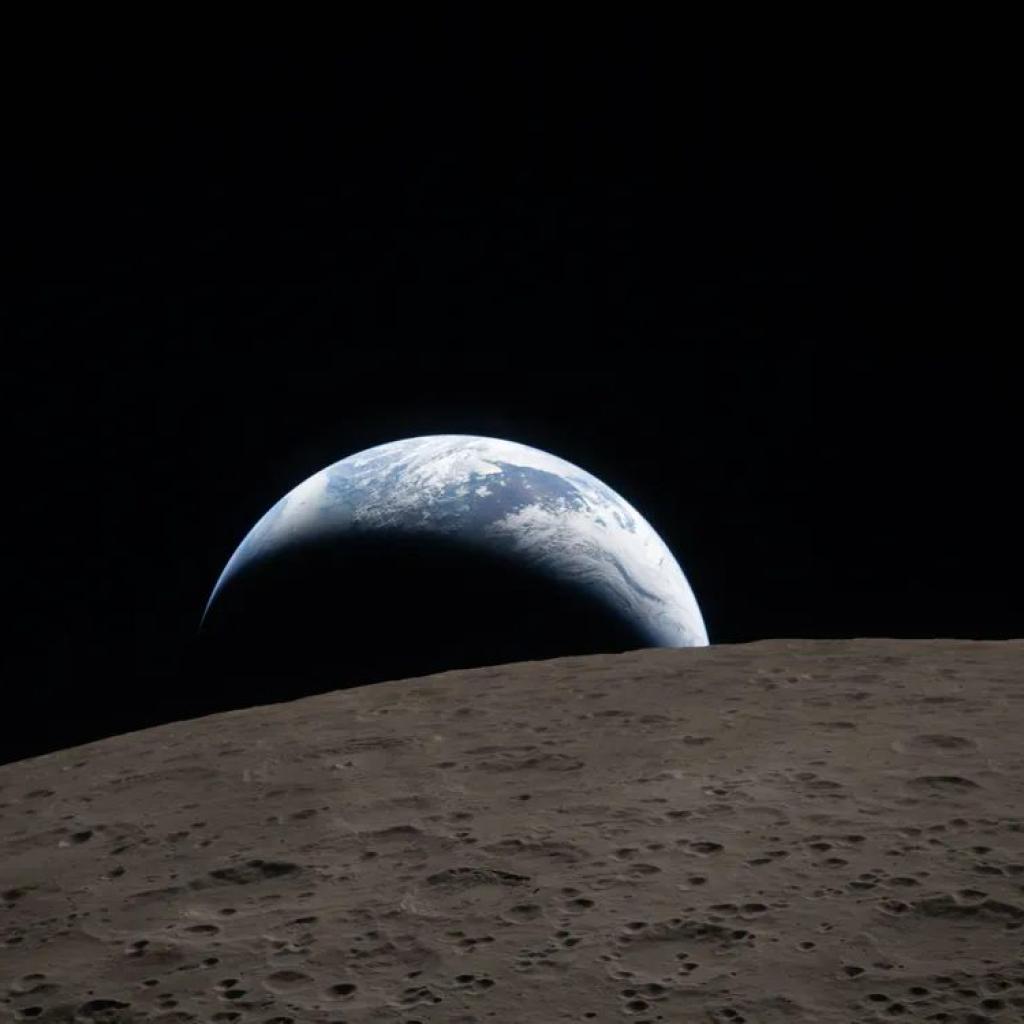
After successfully looping around the Moon and accomplishing its key mission goals, NASA’s Artemis II spacecraft is now on its return journey to Earth. This marks a major milestone in humanity’s renewed ambition to explore deep space and venture farther than astronauts have traveled in more than 50 years.
Artemis II represents the first crewed mission under NASA’s Artemis program and the first time humans have journeyed beyond low Earth orbit since the historic Apollo missions. The mission demonstrates technological advancements and provides crucial experience that will support future lunar landings and deep space exploration, including possible missions to Mars.
The Orion spacecraft carrying the four astronauts is expected to re-enter Earth’s atmosphere and safely splash down in the Pacific Ocean, off the coast of San Diego. NASA recovery teams, working together with the United States Navy, will be positioned in the landing zone to retrieve both the astronauts and the spacecraft once splashdown is completed.
SPLASHDOWN schedule confirmed
According to NASA’s mission timeline, Artemis II’s splashdown is scheduled to occur at approximately 8:07 p.m. Eastern Time (5:07 p.m. Pacific Daylight Time) on Friday, April 10, 2026. This timing corresponds to 4:07 a.m. Gulf Standard Time on April 11, 2026.
The astronauts followed what is known as a free-return trajectory during their journey around the Moon. This flight path uses the Moon’s gravitational pull to naturally guide the spacecraft back toward Earth without requiring a significant engine burn. The approach is considered "safer" because it provides a built-in return route in case of technical difficulties, while also conserving fuel and improving mission efficiency.
Full-systems test before lunar landing
Artemis II is designed as a comprehensive systems test before NASA attempts to land astronauts on the Moon during the upcoming Artemis III mission. Throughout the journey, astronauts carefully evaluated multiple spacecraft systems, including navigation controls, communication links, and life-support technology.
Engineers on Earth continuously monitored how the Orion spacecraft performed under the harsh conditions of deep space. These conditions include high radiation exposure, extreme fluctuations in temperature, and communication delays caused by the vast distance between Earth and the Moon.
Testing spacecraft performance in such an environment is critical because future astronauts will rely heavily on the reliability of onboard systems when traveling farther into space, where immediate assistance from Earth is not possible.
Re-entry and splashdown challenges
As Artemis II approaches Earth, one of the most demanding phases of the mission is about to begin - atmospheric re-entry and ocean splashdown. During this stage, the spacecraft will enter Earth’s atmosphere at speeds approaching 40,000 kilometers per hour.
At such high speeds, intense friction with the atmosphere generates extreme heat, producing temperatures even hotter than molten lava on the spacecraft’s heat shield. The mission will test whether the Orion capsule’s protective materials and structural design can withstand these intense forces, ensuring astronaut safety on future missions.
Fastest re-entry by crewed spacecraft
Artemis II is expected to achieve the fastest atmospheric re-entry ever attempted by a crewed spacecraft. The data gathered during this phase will help NASA engineers improve spacecraft durability and ensure safe conditions for astronauts on longer missions beyond the Moon.
Scientists and mission specialists have also been studying how astronauts adapt physically and mentally to deep space travel. Unlike astronauts aboard the International Space Station, the Artemis II crew operated far beyond the reach of quick rescue missions, requiring greater independence and decision-making capabilities.
The crew’s experiences and feedback will provide valuable insights into how humans cope with isolation, distance from Earth, and the challenges of long-duration spaceflight. This information will play a key role in shaping future missions to the Moon and eventually Mars.
Post-mission analysis to guide Artemis III
After splashdown, NASA teams will conduct a detailed examination of the Orion spacecraft and its systems. Engineers will analyze each component to determine how materials and equipment performed under the stresses of deep space travel.
These findings will help refine spacecraft design, improve mission safety, and enhance operational procedures ahead of Artemis III, which aims to return humans to the lunar surface for the first time in decades.
Artemis II represents far more than a journey around the Moon. It serves as a critical testing platform for technology, astronauts, and mission strategies that will define the future of human exploration beyond Earth’s orbit.
Source : Gulf News