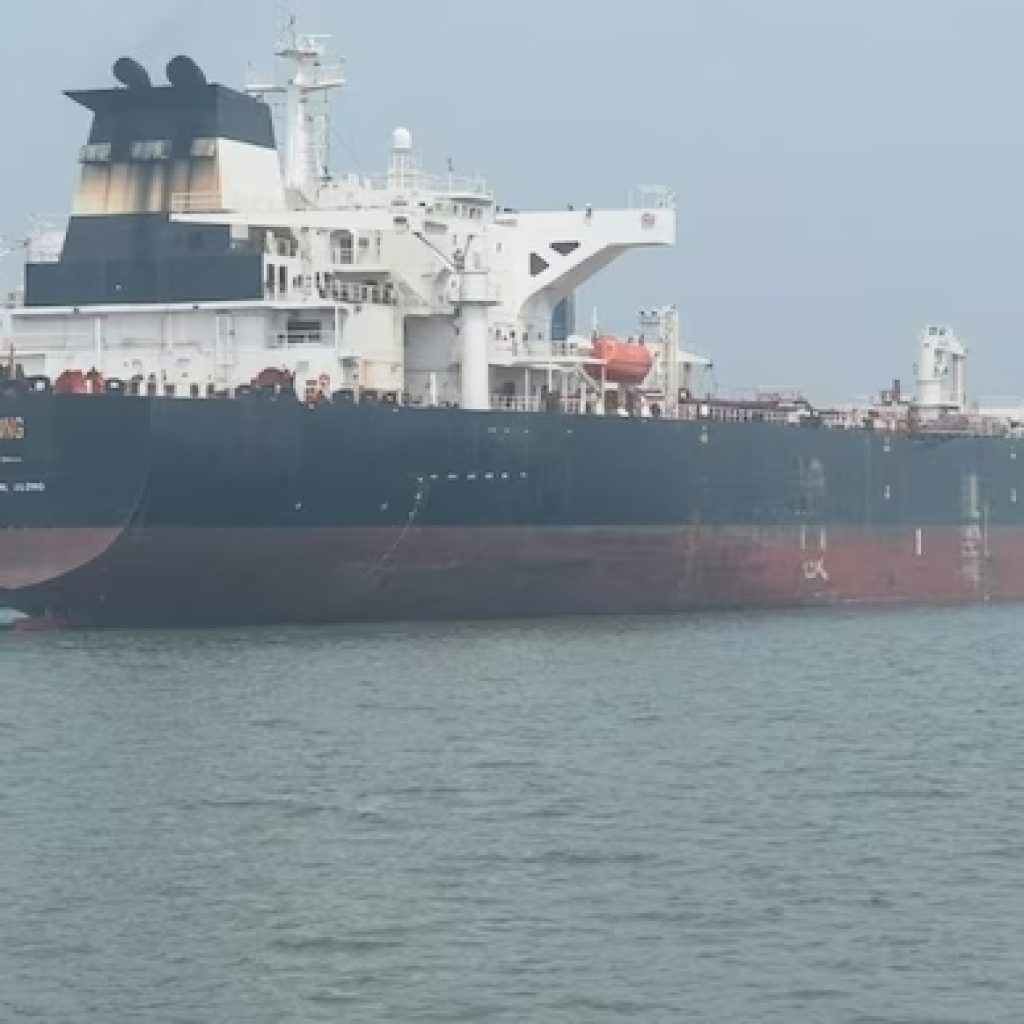
A crude oil tanker commanded by an Indian captain has safely reached Mumbai after navigating the highly sensitive Strait of Hormuz, a key maritime route currently affected by escalating tensions in the Middle East. The vessel, named Shenlong Suezmax, is registered under the Liberian flag and was transporting crude oil loaded from Saudi Arabia’s Ras Tanura port. The tanker successfully docked at Mumbai Port on Wednesday after completing its journey through the strategically crucial waterway.
According to officials from the Mumbai Port Trust, the tanker was able to cross the narrow and volatile Strait of Hormuz after receiving clearance from Iranian authorities. The safe arrival of the vessel comes at a time when concerns over maritime security in the region have intensified due to ongoing military developments and attacks on commercial shipping.
Sources indicated that Iran allowed Indian oil tankers to pass through the strait following diplomatic discussions between India and Iran. External Affairs Minister S. Jaishankar reportedly held talks with his Iranian counterpart Abbas Araghchi, which helped facilitate the transit of Indian-linked vessels through the contested route.
The tanker had departed from Ras Tanura on March 1, carrying a shipment of crude oil destined for India. Its successful passage through the Strait of Hormuz marks an important development for India’s energy supply chain, especially at a time when global markets are closely monitoring the security situation in the region.
The Strait of Hormuz is considered one of the most important maritime chokepoints in the world. A large portion of global crude oil and liquefied natural gas shipments passes through this narrow corridor connecting the Persian Gulf to the Gulf of Oman and the Arabian Sea. Any disruption to traffic through this route has the potential to affect global energy markets and oil prices significantly.
Recent developments in the region have heightened fears of such disruptions. Since the start of a US and Israel military campaign against Iran on February 28, tensions have escalated sharply. Iran has tightened security measures in and around the strait and has reportedly carried out multiple attacks targeting commercial vessels passing through the area.
Reports suggest that at least 16 ships have been targeted in the region since hostilities intensified. Incidents include strikes on a container vessel near the coast of Dubai, a fire outbreak near Bahrain’s international airport, and a drone attack targeting a major Saudi oil field. Additionally, Iraq temporarily halted operations at its oil terminals after an attack on the port of Basra along the Persian Gulf.
These incidents have raised serious concerns among global shipping companies and oil-importing nations, including India, which relies heavily on crude imports to meet its energy needs. India is currently the third-largest consumer of oil in the world, making uninterrupted maritime transport vital for its economic stability.
Amid these challenges, India has also been evaluating alternative strategies to secure its energy supply. One such option includes increasing crude oil imports from Russia and exploring other routes to mitigate risks associated with the Strait of Hormuz.
Meanwhile, the Indian government has been closely monitoring the situation to ensure the safety of Indian vessels and crew members operating in the region. The Ministry of Shipping confirmed that 28 Indian-flagged ships are currently active in the Persian Gulf area.
Out of these vessels, 24 ships carrying a total of 677 Indian seafarers are positioned west of the Strait of Hormuz, while four vessels with 101 Indian seafarers are located east of the strait. Authorities have been maintaining continuous surveillance of their movements and safety conditions.
To enhance coordination and respond quickly to any emergency, the Shipping Ministry and the Directorate General of Shipping established a round-the-clock control room starting February 28. The control center is responsible for tracking developments in the region and providing assistance to Indian vessels if required.
Despite the ongoing tensions, maritime traffic continues with caution through the crucial passage. However, security risks remain high. On Wednesday, a Thai vessel heading towards Kandla port in Gujarat reportedly came under attack while passing through the strait, prompting strong concern and criticism from Indian authorities.
Iran has also issued warnings that the current conflict could lead to a dramatic rise in global oil prices. Officials in Tehran have suggested that crude prices could potentially surge to as high as USD 200 per barrel if the situation continues to deteriorate, nearly doubling current market levels.
The safe arrival of the Shenlong Suezmax tanker therefore offers a moment of relief amid the growing uncertainty surrounding one of the world’s most important energy supply routes.
Source : Gulf News