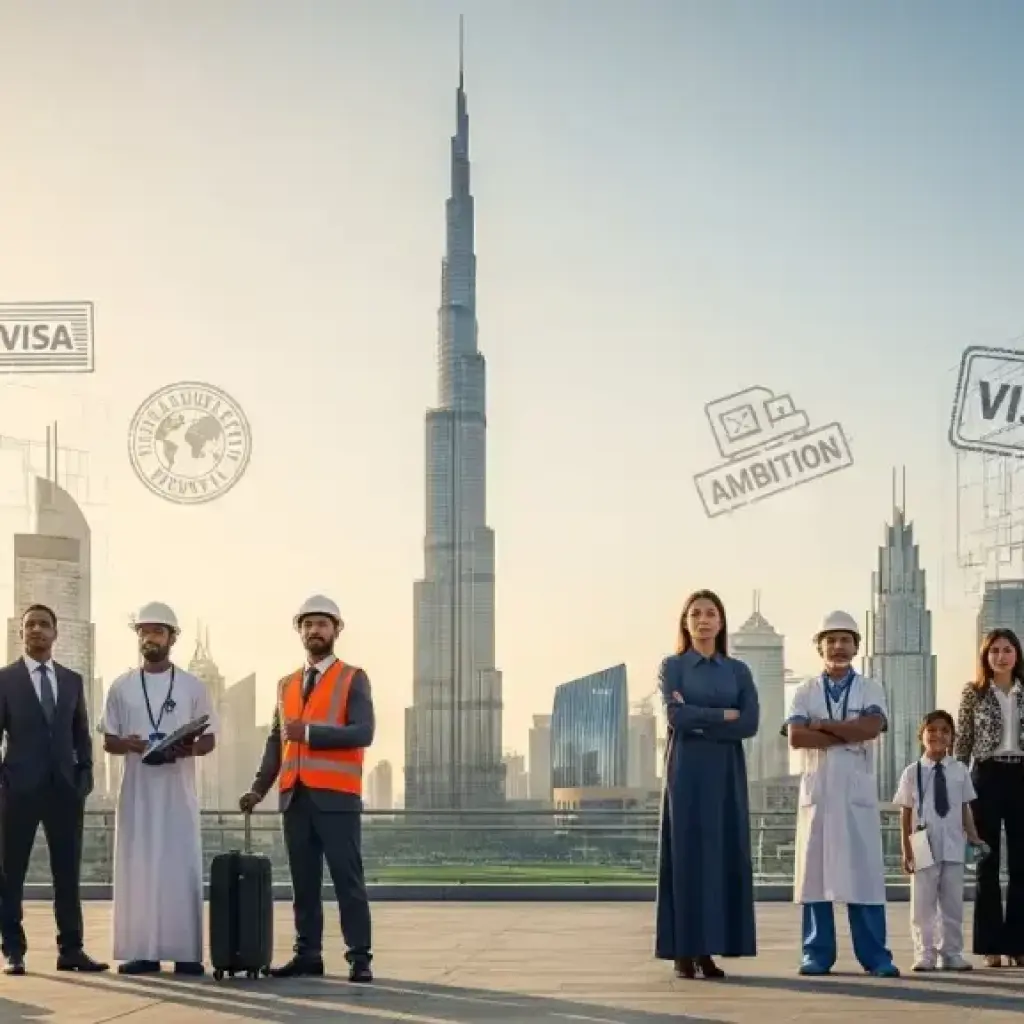
For decades, the United Arab Emirates was perceived by the global community as a high-speed "transit lounge"—a place where professionals would arrive, work for a few years under a strict two-year residency cycle, save money, and eventually return to their home countries. However, as we move through 2025, that narrative has been systematically dismantled.
If you look at the current immigration landscape, you will find a dizzying array of visa options: Golden Visas, Green Visas, Blue Residences, Remote Work permits, and Job Exploration entries. This complexity is not a bureaucratic accident. It is a calculated, multi-layered economic strategy designed to transform the UAE from a temporary workplace into a permanent global home for the world’s most valuable resource: human capital.
Here is a deep dive into the strategic "why" behind the UAE’s diverse visa ecosystem.
1. The Death of the "One-Size-Fits-All" Model
In the past, the UAE relied almost exclusively on the Employment Visa, which was inextricably linked to the Kafala (sponsorship) system. If you had a job, you had a visa. If you lost that job, you had 30 days to leave.
By 2025, the UAE leadership realized that this model created a "transient" economy. To build a sustainable, knowledge-based society, the country needed people to put down roots—to buy homes, start families, and invest their life savings locally. The diversification of visas is the tool used to break the cycle of transience. Each new visa type represents a specific "handshake" between the government and a specific demographic, offering long-term stability in exchange for specialized skills or capital.
2. The D33 Agenda: A Quest for Global Dominance
To understand the visa variety, one must look at the Dubai Economic Agenda (D33) and the broader "We the UAE 2031" vision. The goal is to double the size of the UAE's economy over the next decade and place Dubai among the top three global cities for business and tourism.
To achieve this, the UAE cannot simply wait for general labor. They need surgical precision.
- The AI and Coder Visas exist because the UAE wants to be the world’s most prepared nation for the Fourth Industrial Revolution.
- The Gaming Visa exists because the "Dubai Gaming 2033" initiative aims to create 30,000 new jobs in the esports and gaming sector. By creating "niche" visas, the UAE signals to global specialists that there is a dedicated legal framework waiting for them, making the country a more attractive destination than traditional hubs like Silicon Valley or London.
3. The Golden Visa: Rewarding Excellence and Investment
The Golden Visa remains the "crown jewel" of the system. In 2025, its scope has expanded significantly. This 10-year residency is no longer just for the billionaire class; it is for "Exceptional Talents."
The UAE uses the Golden Visa to "lock in" high-value individuals. If a world-class neurosurgeon, a renowned scientist, or a top-tier software engineer is granted a 10-year visa, they are no longer looking at the UAE as a three-year project. They are looking at it as a decade-long (or life-long) commitment.
- For Investors: A 2-million AED investment in property or a business grants this status, ensuring the real estate market remains buoyant and liquid.
- For Students: High-performing high school and university graduates are given the Golden Visa to prevent "brain drain," ensuring the brightest minds educated in the UAE stay to build their startups locally.
4. The Green Visa: Empowering the Modern Worker
The traditional employment model didn't account for the rise of the "solopreneur." The Green Visa was introduced to solve this. This 5-year residency allows for self-sponsorship.
This is a massive shift in the Middle Eastern legal landscape. It targets:
- Freelancers and Self-Employed Individuals: Who no longer need a local company to "own" their residency.
- Skilled Employees: Who earn at least 15,000 AED per month and hold a bachelor's degree. The logic here is economic agility. By allowing people to sponsor themselves, the UAE creates a flexible labor market where talent can move between projects and companies without the friction of visa cancellations and new applications.
5. The Blue Residence: A 2025 Innovation in Sustainability
Following the momentum of COP28, the UAE introduced the Blue Residence in late 2024 and expanded it through 2025. This is a 10-year visa specifically for individuals who have made extraordinary contributions to environmental protection and sustainability.
Why does this exist? Because the UAE recognizes that the "Green Economy" is the next multi-trillion dollar industry. By offering long-term residency to climate-tech innovators and conservationists, the UAE is positioning itself as the global laboratory for climate solutions, attracting the very people who will solve the world's most pressing environmental challenges.
6. Catering to the "Digital Nomad" and the Remote Worker
The Virtual Working Visa (Remote Work Visa) is a direct response to the post-pandemic world. It allows an individual to live in the UAE while their employer is based in another country.
The UAE’s logic is simple: If you earn $3,500 or more per month from an overseas job, you will spend that money on UAE rent, UAE schools, UAE restaurants, and UAE services. It is a way of "importing" consumer spending without needing to provide a local job. This has turned neighborhoods like Dubai Marina and Abu Dhabi’s Saadiyat Island into global hubs for the "laptop class."
7. Socio-Economic Stability: Families and Retirement
A major reason for the variety of visas is the focus on demographic balance.
- The Retirement Visa: Targeted at those over 55 with significant savings or property. The UAE wants to retain the wisdom and wealth of older residents who would previously have left upon retirement.
- Extended Family Sponsorship: Recent laws now allow residents to sponsor their children up to the age of 25 (and daughters indefinitely), as well as parents with much lower hurdles than before.
These changes are designed to create a "complete" society. When a resident has their parents and adult children with them, they become a permanent part of the UAE's social fabric, rather than a transient worker sending all their remittances abroad.
8. The Job Exploration Visa: Lowering the Barrier to Entry
Finally, the Job Exploration Visa serves as a bridge. It allows fresh graduates from the world's top 500 universities to enter the country for 60, 90, or 120 days specifically to find work.
In the past, you could only enter as a tourist (which legally prohibited job hunting) or with a job offer. This "middle ground" visa acknowledges the reality of the modern job market, allowing the UAE to "audit" global talent before they are officially integrated into the workforce.
Conclusion: A Competitive Edge
The UAE has so many visa types because it has moved from a "Rent-a-Laborer" economy to a "Global Talent Marketplace." Each visa is a product designed for a specific customer: the investor, the scientist, the environmentalist, the freelancer, or the retiree.
By offering this level of granularity, the UAE provides a level of legal certainty and lifestyle security that few other countries can match. It is no longer about how long you can stay; it is about how much you can contribute, and the visa system is the roadmap for that contribution.