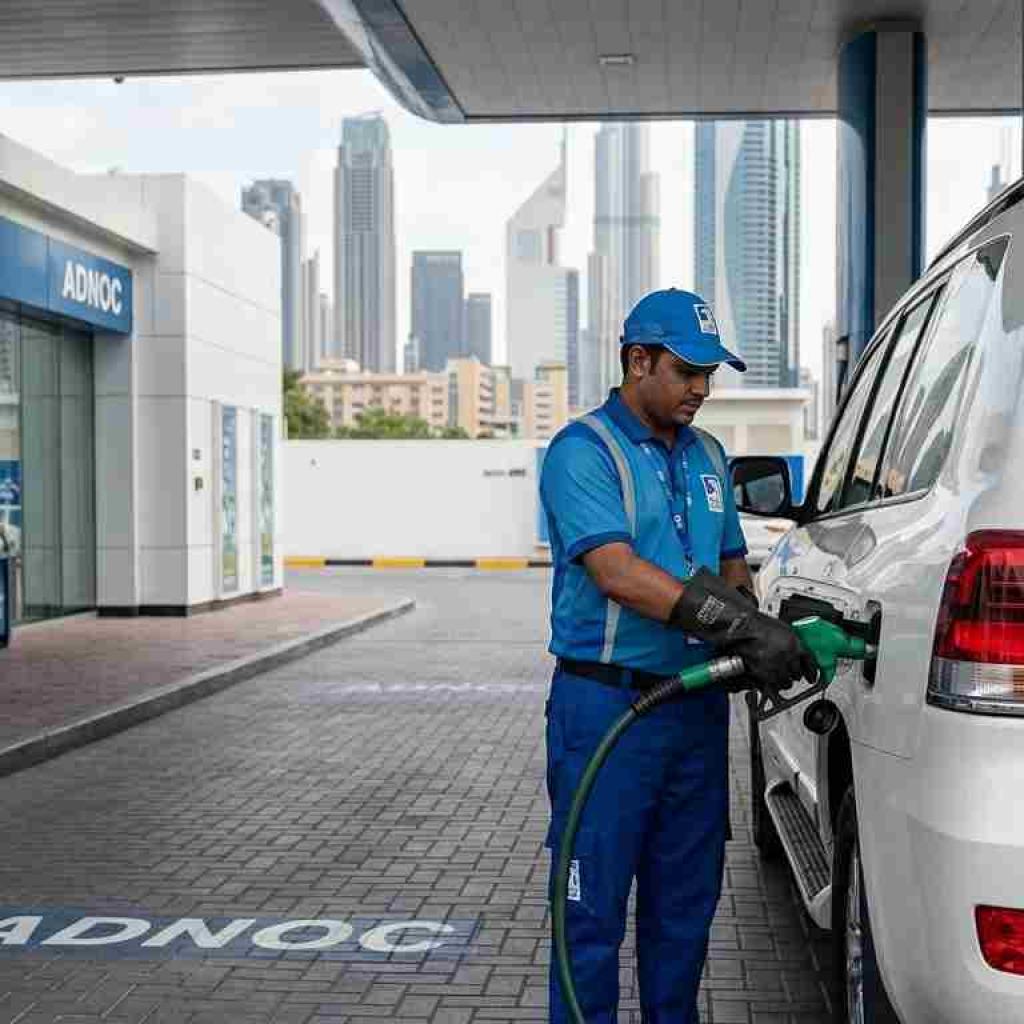
Dubai motorists are closely watching the latest fuel price announcement for April, following a year marked by declining costs, a recent rebound, and growing uncertainty in global oil markets. Over the past 12 months, fuel prices across the UAE have generally trended downward, reflecting softer international crude oil benchmarks throughout much of 2025. This decline brought some financial relief to drivers and businesses that rely heavily on transportation costs.
Prices reached some of their lowest levels in early 2026 before showing a slight upward movement in March. This shift suggested that the period of steady declines may be coming to an end, with prices now appearing to stabilise amid fluctuating global oil trends. As April begins, motorists are once again assessing how international developments may influence what they pay at the pump.
How fuel prices are set in UAE
Fuel pricing in the UAE is closely tied to global oil market movements. Since the deregulation of fuel prices in 2015, the government no longer fixes petrol and diesel prices. Instead, the UAE Fuel Price Committee reviews international crude oil costs each month and adjusts local pump prices accordingly.
This system ensures that domestic fuel rates reflect global trends rather than remaining artificially fixed. The committee calculates prices using the average international cost of crude oil and refined fuel products over a specific period. Benchmarks such as Murban crude play a role in the calculation but are only one part of a broader global pricing structure.
Because of this model, UAE motorists often experience price adjustments that mirror global oil market fluctuations, although usually with a slight delay due to the averaging period used for calculations.
Where global oil stands now
Global oil markets have recently experienced renewed volatility due to geopolitical tensions. The conflict involving Iran and the closure of the Strait of Hormuz in early March triggered a major supply shock. This disruption pushed Brent crude prices up by more than 50 percent within a single month, reaching nearly $120 per barrel.
However, the surge has partially eased since then. Murban crude, one of the key benchmarks relevant to UAE pricing, stabilised at around $115 per barrel after previously spiking as high as $152 per barrel. This stabilisation has helped reduce immediate pressure for sharp price increases, though uncertainty still remains.
According to the International Energy Agency, the disruption caused by the conflict represents one of the largest supply shocks in history. Several countries have released emergency oil reserves in an effort to maintain stability and prevent extreme price fluctuations in global markets.
How UAE compares globally
The UAE operates under a liberalised pricing model, meaning fuel prices adjust relatively quickly in response to global oil market changes. This approach differs significantly from countries where governments regulate fuel prices or provide subsidies to shield consumers from sudden increases.
Sharp increases seen globally:
- Philippines: diesel up over 80%
- Nigeria: nearly 80% rise with shortages
- Australia: diesel up over 50%
- US: diesel above $5 per gallon
More stable markets:
- Saudi Arabia: prices unchanged due to regulation
- India: no increase after tax cuts and state intervention
- China: limited rises through export controls
These differences highlight how government policies influence fuel price stability. Countries with subsidies or regulatory controls may experience slower price changes, while liberalised markets like the UAE reflect global trends more quickly.
How much will fuel prices rise?
The final direction of UAE fuel prices for April largely depends on the global average oil price during the calculation period used by the UAE Fuel Price Committee. Current indicators suggest a mixed outlook.
- The earlier surge in global oil prices could push prices higher
- Stabilisation around $115 per barrel may limit the increase
- Recent volatility introduces uncertainty into the final calculation
Because of these competing factors, motorists may see only a moderate increase, stable prices, or minimal changes compared to March rates. Much will depend on how global oil averages settle towards the end of the pricing window.
The official fuel price announcement expected today morning will confirm how global market movements ultimately impact local pump rates for April. As geopolitical tensions and supply concerns continue to influence oil markets, UAE drivers can expect fuel prices to remain sensitive to international developments in the coming months.
Source : Gulf News